Showing posts with label Features. Show all posts

Tuesday, 15 March 2011

Red China Turns Green Giant

ICONIC: CCTV Tower in Beijing is a real spectacle.


AS Jamaican sprinter, Usain Bolt, crossed the Olympic finish line in 9.69 seconds at the 2008 Beijing Olympics in the iconic Bird’s Nest Stadium the world stopped to take a second look.

So the Chinese had succeeded, as splashing out on the most expensive Olympic games of all time and building some of the most spectacular buildings ever seen, made the world sit up and take note.

No longer do Stalinist structures dominate the communist landscape of the world’s most populated nation with such prevalence.

Instead they now form the historic backdrop to what China has become, an economic show pony with grand ambitions.

The 80,000 seat, skeletal, Swiss-designed Beijing National Stadium, also known as Bird’s Nest Stadium, is a small part of a huge cultural change, casting polished steel shadows over historic Chinese landmarks.

Even 17th Century Tiananmen Square is now overlooked by an other-worldly futuristic blob, known colloquially as the Alien Egg.

Officially called the Grand National Theatre, the French-designed Alien Egg follows the pattern of western architects being commissioned to shape Chinese cityscapes, suggesting a departure from traditional oriental design.

As a result China and Beijing in particular are now synonymous with cutting edge design and this $300million three-theatre structure, is every bit the grand spectacle.

Another imaginatively named example of extreme development, the Twisted Donut, is a structurally radical, 44 floor loop that acts as the Chinese Central Television Headquarters.

Yet this facade of aesthetic transformation, sparked in part by Olympic ambitions, is seemingly covering the cracks of a painful, forced economic growth.

After communism took hold of China following the end of the Chinese Civil War in 1949, a longing to become the dominant world super-power, despite their drained economic status, led to ecological and social strife.

Over cultivation, over grazing and deforestation have turned around a quarter of China’s land into desert, while an estimated 300,000 people die prematurely every year from polluted air in the country.

And for decades questions have been murmured tentatively from world leaders as to how and why controversially communist China’s immense environmental shortfalls have not been corrected.

At one point it was even believed that on average China opened one new coal-fired power station every week, increasing its emissions more than any other industrialised country put together since 2001.

Typically however, the Chinese were never going to solve this simply.

Instead they, among other things, pledged to build from scratch a showpiece ‘eco-city’ that would support itself through renewable energy created on the island, minus gas guzzling cars and troublesome landfills.

However this more than ambitious plan, proposed to be on Chongming Island, across the water from Shanghai, has been beset with problems and delays since it was announced in 2005.

Recognised as one of the world’s most exciting ecological projects, Dongtan still may become the world’s first zero carbon, completely self sufficient city despite a lack of construction years after it was scheduled to start.

Proposed to home around half a million people in an area about the size of Manhattan, the island still has its supporters and many environmentalists refuse to accept that Dongtan is dead.

And with funds practically spewing from a country with one of the fastest growing economies in the world, such immense environmental undertakings are by no means out of the question.

In fact China has also embarked on an aggressive mission to cut fossil fuels, spending more than $34billion in 2009, more than any other country in the world.


TOWERING: Pudong skyline with soon to be completed Shanghai Tower.


The Chinese now has more hydroelectric generators than any other, is increasing its use of bio-fuels, tops the world in terms of solar power generation and is frenetically increasing its use of wind power.

The Three Gorges Dam, in Hubei province, is all that is modern China.

Considered the largest hydroelectric dam and largest generator of electricity in the world since 2006, this dominating dam measures 1.5miles in width and is the country’s largest construction project since the Great Wall.

This humungous structure, which along with its underground power station is set to be fully operational by 2012, is the tip of the iceberg in terms of Chinese environmental ambition.

Immense projects such as this and the increased push for renewable energy has made red China a green giant.

Projects like these provide a constant reminder of Chinese ambition and innovation in the face of crisis, the centre piece of which however lies to the east, in Shanghai.

In 1992 the then Chinese leader, Deng Xiaoping, described the city as “the head of the dragon” pulling the country into the future.

Shanghai has since experienced massive investment aimed to redress over half a century of neglect.

Yet again, foreign architects were commissioned to transform what was a rundown industrial city into the personification of modernity and more importantly of the new China.

Shanghai’s recent development again is linked in to European design and competitive communism, with an unprecedented skyline that has sprung up from virtually nowhere.

The 88 storey Jin Mao Tower and immense 101 storey Shanghai World Financial Center, in the Pudong district, lie on what was an area of rice paddies and small factories just over twenty years ago.

Home to economic heavyweights like General Motors, IBM and Credit Lyonnais, these buildings are a bold statement of Chinese world ambition, but again it is argued that a ruthless cultural sacrifice has been made.

Similarly Shanghai International Circuit, a spectacular $450million venture, was transformed from swampland within 18 months to become a world renowned Formula 1 race venue from 2004 onwards.

And the construction steam train is by no means coming to a halt as the biggest Shanghai mega structure yet begins to materialise. The Shanghai Tower will be the third tallest building in the world by 2014.

The multibillion dollar glass tower, which will engulf its Pudong neighbours and feature the world’s highest observation platform, is another glowing example of architecture that marks out China as forward thinking.

After decades of decay and environmental neglect, China is now ruthlessly transforming itself from an over industrialised workhorse into a rounded, environmentally viable economic powerhouse.

As the old saying goes, Rome wasn’t built in a day, but China’s relentless charge towards to the top seat in world economics is seemingly inevitable.

Monday, 21 February 2011

Answering the Hero Worship Call

MATURE: Manchester band are looking forward with 'Lifeline'

AS self-proclaimed “giddy kids” upon their 2006 conception, Mancunian indie-pop four-piece The Answering Machine have embarked on gigs in Japan, America and headlined UK tours but for now they’re looking closer to home for their kicks.

On meeting the former University of Manchester students in the cool, vintage-looking Common, in the city’s Northern Quarter, there’s a definite sense of self assurance on the eve of the release of their second album ‘Lifeline’.

A band from humble beginnings, who fit right into the bare brick, cosmopolitan backdrop with instruments in hand, fresh from practice at a nearby rehearsal studio, they still carry that approachable image from their early days.

Initially started by lead singer Martin Colclough and guitarist Pat Fogarty, the group soon took shape with the addition of bassist Gemma Evans and a battered drum machine nicknamed ‘Mustafa Beats’ five years ago.

Before long the skinny jean-clad, indie trio were being tipped for big things, yet only after being courted and dropped by a major record label before ever signing up did they finally hook up with DIY specialists, Heist or Hit Records.

Martin explains: “We didn’t have the drive to be like this self sufficient indie band, it was more a case of wanting to be successful and we thought the answer was a label giving you money and buying you the tour you need and all this.

“We understand now it’s a lot more about hard work but I guess it taught us a lesson, it’s a self fulfilling prophecy, if you want a sold out show in Manchester you have to work hard for it.”

The group, who self-produce their work, also self-promote and even are integral to the running of their London-based label.

Mustafa was soon binned under Heist’s tutorship and drummer Ben Perry filled the gap that the electronic enigma had left, before the band finally released their debut album, ‘Another City, Another Sorry’.

Sat crowded round a small coffee table, the group remain fully aware of the pitfalls that come with the kind of hype that they received.

Timid drummer Ben continues: “The first album’s definitely something to be proud of but it’s mad when you see bands come through and get the hype that we did, get loads of support from the media and then the next minute they’ve split.”

Pat weighs in: “It’s weird to think when we’ve got friends on major labels, the whole expectation of what you are basically all of a sudden is not about writing the best pop or whatever.

“It becomes about how many gigs you sell out, how many units you’ve shipped and if you chart.”

And it wasn’t long before the music press began to categorise and pigeon hole the foursome as Wombats-esque, although they actually started out at much the same time, something which doesn’t seem to sit terribly well with the group.


LIFELINE: Second album now released


“It’s fair to say that they used what they had more to their advantage than we did, we were quite humble and happy with what we had whereas we didn’t really see the money making side,” Pat explains.

“I suppose it is upsetting to see that maybe some of their fans could also be our fans but they might not get the chance to hear us, but we’re not bitter at all as it’s no fault of their own.”

Charmingly down to earth, the group let the conversation flow and jump in whenever they feel the urge. These aren’t giddy kids anymore that’s for sure, as they settle into conversation about ‘Lifeline’, which was launched at The Deaf Institute last week.

Self-penned and produced, the 11 track ‘Lifeline’ album is an upbeat collection of mellow indie-pop anthems which the band claim is much more personal to them than its predecessor.

Slurping his drink through a straw, outspoken Pat adds: “There was no point in doing an album just like the last one, so this time we brought instruments in that we haven’t used before.

“Next time it could have other electronic influences or we could go down another route,” before Martin interrupts, laughing: “Operatic? or aborigine?”

Now it remains to be seen whether aborigine indie-pop takes off but there is a certain optimism about the band and their new album, particularly as Mustafa Beats has made a cameo appearance from beyond the bin.

Gemma explains: “The way I always describe it is mature sounding. We were 20 when we wrote a lot of the songs in the first album and we’re all around 25/ 26 now.”

Yet despite having supported bands like The Manic Street Preachers, The Rumble Strips and Tokyo Police Club as well as having played with their Mancunian friends The Charlatans, the grounded four-piece still get star struck.

“For me when we toured with the Manics, James Dean Bradfield didn’t really make me star struck like you might expect but Nicky Wise just had this thing about him,” Gemma grinningly reminisces.

“I mean I didn’t even grow up as a big Manics fan but even I was like ‘Yeah that’s pretty cool’.”

In fact The Answering Machine have also become synonymous with video game, FIFA 10, after their song ‘It’s Over! It’s Over! It’s Over!’ featured on the game’s soundtrack, but that is no measure of success for the group.

Martin adds: “I don’t think we’re driven by commercial success as such, we just want the right kind of people to enjoy us, a credibility I guess, that’s all we strive for really.”

Slurping up the dregs of their assorted drinks, everything from a rock and roll mid-afternoon beer to a less so vimto, the eclectic collective have little in the way of a master plan. If anything it’s more of a dream lifestyle that they aspire to.

“We do enjoy going on tour and stuff but that’s not what drives you, it’s all about writing that sound or writing that album,” Martin explains.

“Once we’ve put together ‘Lifeline’ it justifies that lifestyle and that travel around Europe and all that, but that’s another dream.”

The Answering Machine’s second album, ‘Lifeline’, is released on February 21st before they play at Manchester’s Sound Control on March 24th.

Also published on www.thenatter.co.uk.

http://www.thenatter.co.uk/2011/02/answering-the-hero-worship-call/

Monday, 22 November 2010

People's History Museum's Funding to be Slashed

CUTS: Museum facing funding issues


CULTURAL vandalism isn’t a phrase I’ve come across too many times before but on first listen it sounds more like rebellious childhood graffiti than harsh governmental cuts.

But critics argue culture in Manchester could be seriously defaced after non-national museums in the city were told that their government funding will be slashed yearly until its removal in 2014-15.

So what does the future hold for the People’s History Museum (PHM), in Spinningfields, as it looks set to lose all of its £170,000 of annual DCMS funding?

This cuts come partly from how museums are classified as national by the Department for Culture, Media and Sport (DCMS), which relies on whether they were created by the government, not the importance of their collections.

The cuts, which total around 15% of the PHM’s total income, come in spite of the PHM documenting the nationally significant history of democracy and working people in Britain over the last 200 years.

Katy Archer, director of the PHM, said: “Cultural organisations are seen as soft targets and they’re not valued as much.

“But when you’re looking at cuts to education and health instead, it’s difficult for us to make an argument.

“With any financial crisis you need to be confident and passionate but equally you need to be aware of the bigger picture. We’re optimistic but we’re also aware that it’s not going to be an easy ride.”

However, this funding rollercoaster comes after a partly government funded high point in which the PHM received a £12.5million facelift, finally reopening in February this year.

This came before October’s Comprehensive Spending Review revealed that the DCMS itself is set for a 24% budget cut.

Since starting its collection in the 1960s the PHM has popped up in different forms with its latest incarnation featuring a futuristic weathering steel facade that looks like a rusting beehive.

“We were fortunate that we got the money for redevelopment when we did, it wouldn’t happen now on that scale,” explained Ms Archer.

“I think it is a risk not to invest regularly in us as Manchester’s museums do excellent work as a consortium but I appreciate the need to think differently.”

Furious campaigners have since grouped together to sign an open letter addressed to Prime Minister David Cameron, with academics, politicians and union members collectively condemning the PHM cuts.

“At a time when we face huge cuts in the welfare state, the lessons of history that are represented by the PHM are important for all of us,” argued Martin Empson, of the Manchester Right to Work campaign.

“At a time when education is also under attack, institutions like museums have an important role.”

Unionists have taken particular offence to the PHM cuts, as the museum depicts 19th century trade unionism and houses the world’s largest collection of trade union and other banners.

Geoff Brown, secretary of Manchester Trades Union Council, added: “The shift in government priorities is not only unnecessary but a huge gamble.

“The idea that the free market will create an unprecedented number of jobs to replace the million that will go if the Comprehensive Spending Review is implemented is a massive risk.”

Private sector sponsors like The Co-operative and Unison already back the PHM but there are concerns that relying on such support can’t sustain Manchester’s museums long term.

Furthermore the idea that the local government spending review could dent the PHM’s finances even more is leaving a cloud of uncertainty over its future.

But Councillor Mike Amesbury, Manchester City Council’s Executive Member for Culture and Leisure, refutes such claims.

“We have no plans that serve to cut PHM funding although I believe the DCMS cuts are an unprecedented knock on arts and culture in Manchester,” he said.

“It’s nothing but short sighted cultural vandalism. We will now work hard behind the scenes with cultural partnerships and look at shared services and backroom operations.”

He added that sponsorships will fall short of replacing government funding.

Cutbacks have also brought fears that admission fees could be introduced at the museums for the first time, despite the Conservative election promise to safeguard against them.

Ms Archer admitted: “It probably will be a conversation that will come up before 2015 depending on the local government budget announcement.”

In fact the cuts will also affect national museums with their DCMS funding being reduced by 15%, which the department argues will not hamper the protection of free entry.

And the man behind the DCMS statement, Rt Hon Jeremy Hunt, Secretary of State for Culture, Olympics, Media and Sport, has defended the museum cuts.

He said: “While we have had to make a number of very difficult decisions, we have acted in a decisive way that maximises the resources going to the front line.

“Our priority now is to get on with delivering the services the public want over the period of this parliament and beyond.”

Manchester’s National Football Museum (NFM) and Museum of Science and Industry (MOSI) along with the PHM form three of the eight non-national UK museums to have their DCMS funding removed.

Tony Hill, director of the MOSI, said: “We have been aware for some time of the need to diversify our funding. The MOSI now has a separate fundraising department to develop new funding streams.”

The NFM risks losing its funding after Manchester City Council pledged £8million for its relocation to Manchester’s Urbis exhibition centre, along with £2million to be invested in it annually.

“While we would be very disappointed if our DCMS funding was cut, it would not affect the creation and future successful operation of the new museum,” added NFM director, Kevin Moore.

So the future of the PHM is very much in the hands of sponsors and potential suitors, but we are yet to see whether that is enough to sustain it.

Scaling down and cutting back may have to be considered to maintain it, but in fighting for their rights, protestors could yet win back funding like those depicted in the PHM’s exhibits once did.

Also published on www.mancunianmatters.co.uk

http://mancunianmatters.co.uk/content/museum-funding-slashed-essential-cuts-or-cultural-vandalism

Sunday, 6 June 2010

The Working Men’s Club- Friendly, Forthcoming but Falling Short

GOOD TIMES: Barrowford WMC in need of more glory days


FROM bingo and beers to pool and pies, the old fashioned working men’s club has been a fixture in towns and cities all over the UK for over a century but in recent years we’ve simply stopped going. Is the traditional club an outdated trend or an important part of British culture? Jonathan Brown investigates...

Having lived just 200 yards away from David Street Working Men’s Club in the small northern town of Barrowford for most of my adult life, it says a lot that I’ve never actually been in the place. It’s always seemed to me like a secret lair for the over 50s and to this day it’s a somewhat scary pebble-dashed fortress but at a time when it is believed around four working men’s clubs are closing every week, surely these perceptions need to change.

Approaching the dominating doorway I can’t help but feel a little nervous and as I walk through the entrance I’m met with a room full of speculative stares. Clearly the under 35 is a rare commodity at David Street. Taking a glance around it’s a surreal sight to behold, the atmosphere is sterile, it’s almost like being in a waiting room. There’s a redundant ‘stage’ with cringingly garish gold tinsel behind it, a derelict dartboard that looks as if it’s never been used despite the majority of the crowd of ten punters looking like retired darts players.

All you can hear is ‘Take Me Out’ on the TV and the odd outbreak of cackling from the hardcore members in the corner. It seems like I’m not the only one too scared to go in.
So maybe it’s just the look of the place and people’s pre-conceived ideas that have caused David Street and clubs like it to become decreasingly popular in recent years.

To my surprise the face behind David Street is not Brian Potter, of Phoenix Nights fame, but instead I am met with the embodiment of the pub land lady, Pam Black. She’s a short, stocky woman who could pass easily pass as the club's bouncer never mind stewardess. Yet despite appearances she is an immensely friendly and passionate lady, who wants nothing more than for David Street to re-live its prime.

“It’s a fact, WMC’s are definitely in trouble but we’re doing okay,” Pam says with a sigh. She continues, “The problem is getting people to come through the doors after you’ve paid artists to perform, it’s a risky game because if we mess up, the club will pay for it.”

In fact David Street pays for acts once every three weeks to come and perform and hopefully pack out the venue but picking the right acts is a challenge in itself. Unfortunately after seeing the far from blockbuster ‘Irish Battle of the Bands’ advertisement from the week before on the notice board I can see why the club wasn’t packed to the rafters that night. Thankfully for me the club won’t be featuring any Daniel O’Donnell tribute acts tonight however.


The club can actually hold up to 100 people but on a night like this, with a sparse crowd littering the function room that you could count on your fingers, you can infer that Pam is keeping her cards close to her chest. The clues as to how they are doing are there for all to see, most of the spotlights in the ceiling aren’t working and there is a plug-in heater in the middle of the room because the heating is ‘broken’.

The fact that people have many preconceptions about WMC’s surely can’t help but Pam is quite proud to say that David Street is traditional. “Yes we are old fashioned and we do still have bingo and cabaret artists but that is what people love about clubs like this one. We are very welcoming to younger people though, we even let people order in takeaways and eat in the function room, it’s like having an extended family,” she explains.

And I can sympathise with her, the atmosphere of a WMC is a lot quieter than that of a pub and seemingly more sociable, the characters you find in places like David Street are fantastic. Take Frank for example. The larger than life forty-something having seen me at the bar chatting to Pam is adamant that I’m Casanova in disguise, shouting, “Don’t give him your phone number Pam!” These people make the place what it is but after all the club itself is over a hundred years old and some of the punters aren’t far from that milestone themselves by the look of it. Glancing round some are even asleep.

Having never been in the club before, I have to admit that I was expecting a far icier reception. But if anything, a new person being there just intrigues the regulars and before you know it you’re bombarded with questions and you feel instantly welcome. Despite this the perception still remains amongst many that unless you’re called Trevor, Graham or Shirley and you’ve worked as some sort of engineer or you’re an expert bingo player, you’re likely to feel as welcome as a horse in a nightclub in a place like this. But during these difficult economic times clubs like David Street can’t afford to be selective.

The WMC in Britain is in crisis because of far more than the odd bad tribute act or because of the 80s decor however. In the past decade social change has simply left the old fashioned club behind and now it is struggling to pick up the pieces. The smoking ban, recession and cheapening supermarket prices have driven people away from traditions and into less communal, cheaper ways around these modern day hurdles, even pubs are feeling the pressure at present. The heyday of the WMC, it appears, has long gone judging by the fact that since the 1970s the number of registered working men’s clubs in the UK has been nearly halved and the number of clubs is continuing to drop, so are they really worth saving?

As I sit pouring the rest of my pint can into a glass in Barrowford’s very own version of the Phoenix club pondering the question, it dawns on me how important to some people the working men’s club really is. You just don’t get random people coming up and introducing themselves to you in even the most friendly pub. WMC’s are innocent, lessening communities of people who simply enjoy the familiarity and sociability that comes with a membership. These clubs are a glance into days when you left your front door ajar and if the neighbours walked in for a chat you’d welcome them with open arms.

Because of this it seems Pam is as determined as ever to revive the club’s fortunes and she is adamant that they are starting to reel in a new generation of customers of which Matt Burton is one. The 18 year-old student and his friends have only ventured into David Street a handful of times but it seems Pam and the club’s committee are pinning their hopes on youngsters like them.

“As much as this place is a dead most of the time, to be honest, the main reason we come is for a couple of cheap drinks and to play pool because there’s never a cue for the table,” he explains. “We do feel a little bit out of place when we’re in here and just go straight up to the pool room, they are so trusting that they even gave us the keys to upstairs the first night we ever came down,” he says.

So for the likes of Matt at least the appeal of being associated with a WMC is minimal which doesn’t bode well for the future and it has to be said that a lot of locals probably wouldn’t notice if the tinsel clad club called it a day. In contrast the regulars would certainly have a thing to say about that, as for many clubs such as David Street memberships go back generations.

But as Pam admits herself, the characters that have kept David Street alive in recent times are themselves becoming few and far between. “There’s a lot dying off and we are actively trying to get new people in, we’ve even bought a Nintendo Wii which will hopefully bring more customers in,” she optimistically explains.

Yet with all this in mind you can’t help but feel a little bit downbeat about the future of such clubs that have decades upon decades of history and tradition behind them. The youth seem disinterested and the nation is hardly calling out to see more cheesy variety acts at present, so this may well be a final farewell to the humble working men’s club.

However there is a glimmer of hope as far as Pam is concerned, as the club has started to go down the route of renting out the venue itself for private functions a lot more recently, such as for Christmas parties and birthday celebrations.

She asserts: “The future for us at the moment is in putting on private functions because we just don’t get enough punters on a regular night whether it be a weekend or midweek. If we attract enough functions we’ll do okay.”

As the night winds down and the punters clear their tables the community spirit of the good old fashioned working men’s club rears its head. The camaraderie of the place and willingness to support each other is a humbling flashback to a bygone era and despite it being left behind by social change I’m quite sure that the togetherness of the WMC is more than worthy of a place in modern society even if Daniel O’Donnell impressionists aren’t.

Thursday, 27 May 2010

Manford of the Moment

AMBITIOUS: Colin Manford looking for success

THE clean cut style, cheesy grin and quick wit of Manchester’s most exciting comedy export, Jason Manford, are qualities that you might also expect to find in his tight knit family. For the most part you’d be right but Colin Manford’s straggly beard, glasses and lesser bank balance set him far apart from his nationally acclaimed brother and as he sits across from me in a busy city pub, most punters are unaware of his comic talents.

But despite appearances, the star’s younger brother is also taking to the stage after a somewhat chequered few years in and out of colleges and odd jobs. After leaving school, the six foot plus, larger than life youngster hadn’t a clue of what his future might hold and stand up comedy wasn’t even on his radar, in spite of his instinctively witty personality.

Colin’s ability to make light of things was a necessity when growing up however, as the Manford family struggled in the working class Whalley Range suburb of Manchester during his early life, yet for years he has shied away from the spotlight. “We grew up with pretty much nothing, so you have to entertain yourself and come up with your own stuff. As far as family goes, it’s full of entertainers especially on my mum’s side, even my other older brother who is a plumber is also a part time magician,” he explains.

In fact after re-taking some school exams the self confessed class clown ended up on a mundane communications course at a local college which he seemed destined to fail from the start. “It was just dire, I only lasted 6 months. My decision to leave was based on a Tuesday because I used to get home when it was dark and I just didn’t like that,” he says with a rye smile.

And this became a recurring theme as the unmotivated joker unsuccessfully went through several colleges before taking an unexpected two year detour. As Jason broke into mainstream TV, Colin was asking if you wanted your sandwich toasted at your local Subway as he continued to search for his calling. “These last few years have been mental, I often sit back and think what am I doing, why did I work in subway for two years.

“At the time it was only supposed to be a stop gap but I just got comfortable. Living at home with no bills to pay, getting £300 every two weeks with a Wetherspoons down the road, I was like a full on alcoholic for two years,” he recalls.

But after eventually pulling himself away from the beer and butties he did some teacher training and eventually followed in his brother's footsteps by working his way on to a media and performance course at the University of Salford, where he finally started to ask questions about comedy. In fact after years ignoring his ability to make people laugh, he finally took the leap of faith into stand up comedy in 2007 but it wasn’t all going to be ovations and encores straight away.


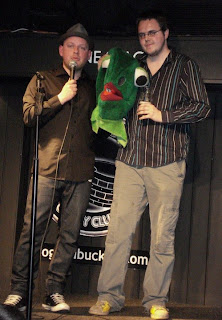
WINNER: Colin Beats the Frog


The bumbling funny man pretty much fell in at the deep end by entering ‘King Gong’ at the Comedy Store in Manchester, where comedians get a tiny five minute berth on stage to avoid getting gonged off by a rowdy crowd.

“I thought about it just before uni and then I finally caved in to one of my mates. Doing King Gong at the Comedy Store was honest to god the worst day of my life,” he explains. “Beat the Frog is friendly, it’s a nice one, even if you get gonged off. But King Gong is brutal, it’s hostile, the compere encourages the crowd to heckle but I got the two mixed up and signed up for King Gong. I lasted two minutes.”

A shattered Manford was drowning his sorrows in the club’s foyer when veteran comedian Mick Ferry offered the young amateur a pep talk and within days Colin was back on stage at Beat the Frog, which he duly won at the first attempt. He says: “Mick basically told me to keep writing as not every audience is going to like every joke you write, it’s not all about acting like a mentalist like they do at King Gong and he was right.”

Colin’s baptism of fire into the world of stand up was a real wake up call to him of his brother’s achievements and now he hopes to emulate Jason’s achievements having seen the blueprint. “Straight off I’d say my brother is someone I look up to. I mean because we’re so close and because he’s grafted so hard, now I know what can happen if I graft hard. He’s done his education, finished uni and he’s doing brilliantly,” he says proudly.

But as a result of his brothers huge success, Colin was so wary of becoming pigeon-holed as some sort of tribute act that for his first two years as a stand up he all but dismissed his identity, working under the pseudonym of Colin Charles. He explains: “It’s difficult for me because I’m immediately cast as Jason’s brother, I mean I don’t use Jason’s jokes and I don’t talk about him so why should I be presented to people using his name?”

Following a two year crash course in comedy under his new name, during which he built up an admirable reputation, Manford finally unveiled his identity at the comedy Mecca of the Edinburgh Festival last year.

“I’m proud of what I achieved as Colin Charles. It’s just because I didn’t want to be labelled back then and I got fed up eventually. It’s my name too, it’s for my parents, wanting them to feel like there’s another Manford out there making it but I’ve got a long way to go,” he continues. “Now I use my name as a plus point because if people say you’re just Jason’s brother then I get on stage and prove to them that I’ll be funny off my own back.”

And it has to be said that Colin is definitely his own man when it comes to his comedy. Jeff Davis, a local student living in Salford, saw both Jason and his young apprentice at the same Beat the Frog contest last year. He says: “Colin was great on the night and he got a really good reception. His jokes were a lot darker than Jason’s though, they’re both great story tellers but Colin swears a bit more and talks more about student life. He did remind me a lot of his brother though, just because of his mannerisms really but that’s always going to happen with brothers.

“I wouldn’t be surprised if I saw Colin on TV in a year or two, he’s definitely one of the better comics I’ve seen but it often takes years before you see a club comic on mainstream shows. I think he has a great future in stand up from what I’ve seen.”

Now in his third year as an aspiring comic, Manford is gigging at least three times a week in and around Manchester and the North West with the ultimate aim of reaching the big time. As he sits back, takes a gulp of water and explains his grand aims, it’s clear that he’s ambitious. But the burden of his brother’s success has meant that some promoters have tried to market him by using Jason’s name, something which Colin despises, but you can’t help but wonder when that might end. “He’s not going to be here and our materials is not the same so that does annoy me, some people take the piss like that,” he says.

In fact Colin is setting his sights on conquering more than just the stand up genre with other projects that include directing and starring in his own independent film, starting a production company and trying to get acting work. Comedy is clearly his greatest passion however, as you can’t help but share his enthusiasm when he talks you through his favourite stand up moments. He clears his throat and gestures a 3D image of his favourite gig and you feel compelled to be taken on his comic journey.

“There must have been 350 people crammed into the Frog and Bucket and I was warming the crowd up for the competition, it just felt like it was the best gig of my life,” he excitedly recalls. “I don’t usually get hecklers either but this time I did because is slagged Salford off and there was this crazy, fat woman from Salford on the balcony and she started threatening me. She even gave me the gun signs and then she flashed me, the biggest black bra I’ve seen in my life. I managed to get a standing ovation after that, I had a really good gig.


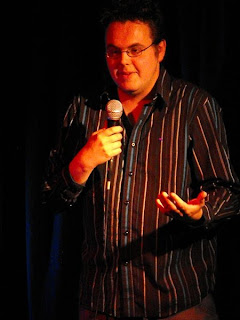
SHOWMAN: Colin on stage

“I think the best thing that came out of that was when her husband came up to the stage and asked the compere why they were thrown out, so the compere said: ‘Well your wife just threatened to kill a comedian, so I think that’s grounds to be kicked out of a comedy club, don’t you?’,” he laughs.

But unfortunately the life of a young journeyman stand up is not all that glamorous and more often than not Colin finds himself working for free at charity events and club nights that could not be further away from the limelight. Yet as much as he’s not the biggest fan of the old working men’s club, it certainly beats subway.

“I’m one of those people who cant say no to anyone so I’ll end up doing charity events for people and more often than not they’re just shambolic. I did one last week for Age Concern in Heaton Norris and it was just brutal,” he continues. “I mean before hand I came up with all these new jokes and ideas to try and when I got there the crowd was literally age concern.”

The upbeat comic is happy at the moment just to get out there and gain experience, with a more than supportive family firmly behind him and expert advice from his celebrated sibling. In fact Colin is keen to learn as much as he can from someone who has been there and done it, and there’s sure to be a lot of laughs along the way. “He’s dead interested as well in what I’m doing, we have a lot of banter and he’s always putting me down in front of people in a friendly way, with the whole ‘he’s trying to be a comedian’ joke,” Colin smirks.

As he slurps the final dregs of his water, it’s clear Colin has found his passion and with a brother of whom he is proud and who gives him constant support besides the banter, you can’t help but back him to go all the way. But there is still something missing for Colin as despite the fact that Jason has appeared on the same bill as him, he’s never actually seen Colin’s stand up. “Performing in front of Jason is one thing I’d love to happen because I’ve performed in front of my mum, dad and my other brothers and even a girl who I used to be in love with, which was petrifying. I know he’ll give me good advice,” he says.

So even when the teasing and jokes are flying, Colin rests in the knowledge that although his brother is nationally known, the mutual respect that they have for each other remains unblemished. “I even did an interview for Manchester Radio Online and Jason rang up and tried having a go. He made a comment saying that when I realise I’m not good enough and I give up, he’s going to buy my jokes off me and I was like alright, okay,” he smiles. “At least my jokes are good enough that he’d want to buy them.”

Friday, 21 May 2010

Manchester Has Increased Volcanicity!

VOLCANIC: Icelandic volcano spews ash all over Europe


BATHED in sun in one of Eastern Europe’s finest cities, in an upbeat beer garden in mid-Easter, the last thing you expect to hear is that a volcano has erupted and closed down airspace all over the continent and more importantly for me, Manchester. But the massive ash cloud that engulfed most of Europe’s airspace has had far reaching after affects on the home of Eccles cakes and Oasis. Jonathan Brown reports...

Possibly the most depressing site I have ever witnessed in my life was the departure boards at Prague Airport. Hundreds of flights all not so subtly marked with massive red capital letters as “CANCELLED”. Thousands of dreary prospective passengers litter the terminals sat on their bags, looking as if they’re contemplating whether they might be able to get a pilots licence and fly home before budget airlines can seat them in squalor class stools on the next tin bird back home. Scenes that echoed across Europe.


GUTTED: Holiday makers stranded

News of volcanic proportions meant that me and my worse for wear friends had two options to get home, either at least an extended stay in the city with zero money or a four country trek back home in complete discomfort. Choosing the latter on a somewhat ill-advised whim, the gruelling £350 journey home began with a monstrous ten hour minibus ride to Paris in a cramped people carrier with six unwashed men and a Czech native driver, Chavros, who spoke little to no English.

But I was one of millions of travellers stranded across the continent with limited means with which to get home and in Manchester around 300,000 people due to fly in or out of the airport were stuck. The unprecedented closures have meant that people have had to resort to everything but horseback to get to their destination and for us, Chavros was only the first leg of a torturous, hunger ridden marathon. Being part of that statistic isn’t all fun and games I hasten to add but some Mancunians had to travel from as far as India by land to get back to the northern Mecca that is Manchester.

In fact of the 120,000 Brits who have been stranded abroad since the closures, some are still struggling to get home weeks after the airports were re-opened as for many who holidayed outside of Europe flight cancellations have sent them right to the back of the cue.

Manchester was also a scene of panic as travellers scrambled together plans to get home, meaning we weren’t the only ones reverting to the roads. Taxi services across the region got calls for huge cross country fares such as the Lynx taxi firm in Stockport who bagged a £3,600 fare for taking 21 Americans to Madrid on a 1,200 mile journey south. Amber Cars and Radio Cars Manchester have also taken punters as far as Dover and Hull for ferry crossings costing hundreds of pounds a piece.

Despite this it hasn’t been all good news for Mancunian cab drivers. For many, the everyday fares that they might get to and from the airport have fallen foul of the volcano, leaving hundreds of drivers sat at home watching slow motion replays of eruptions and listening to newsreaders attempting to pronounce Eyjafjallajokull on the local news.

It has to be said though, Czech cab driver Chavros didn’t look like complaining as he gleefully counted the 1,000 Euros that we reluctantly paid him for our 650 mile journey to Paris. After a short four day break you cant help but curse your luck when on the second to last day all flights across Europe are grounded because of a volcano.

Despite our evident self pity and the fact that Chavros was starting to look like a somewhat broken man the more energy drinks he downed, the poor guy tried his very best to keep us in relatively high spirits at least. He attempted to cheer us up by talking to us about random Czech footballers and Manchester United in broken English but realistically the best near conversational offering I could return was a Haribo sweet which he duly gobbled up. Little did any of us know, however, that local sport back home was going to be affected in such a dramatic way.

Coincidentally during this first weekend of blanket closures the biggest game on the north-west’s footballing calendar was set to take place, the huge local derby between Manchester United and Manchester City. This clash of the titans was certainly a must see for any seven of your average Manchester based travelling students, stranded hundreds of miles away from home and we were no exception. But even something as localised as 22 mainly foreign, overpaid footballers playing for two local teams was interrupted somewhat by Thor’s volcano.

The scheduled referee for the game, Steve Bennett, happened to be another of the thousands stranded abroad, this time in Romania as he attended a refereeing course in the days prior to the momentous match. The game still went ahead after a last minute reshuffle but this was nothing compared to the lengths some of the area’s sports had to go to make sure their games went ahead.

Salford City Reds rugby team endured a torrid case of bad timing as they had a hugely important Challenge Cup fixture away in the south of France scheduled for that weekend against Catalan Dragons. With the sport’s governing body keen for the fixture to go ahead, Salford found themselves with little option but to make the arduous drive south to Perpignan or face some unhappy executives. Club spokesman, Paul McNally, helped to organise the trip and feels that some used the passion for their local team to make the trip against the odds, “It hit the fans quite hard because a few had booked flights, but some of the hardcore still managed to drive down which is beyond the call of duty really,” he said.

The teams journey was a mammoth one as they battled to keep the players from getting muscle cramps, “It took 37 hours of coach travel to get there and around five and a half days for the round trip instead of the normal hour flight each way,” Paul explained. “They stopped frequently every two hours or so to stretch and for breaks and they stopped in a couple of hotels along the way.”

It really isn’t hard to imagine how much discomfort the players must have been in, as they average 6 foot-plus in height and each weigh about the same as a pet elephant, but they had to make do. Paul added: “They even did rotas as to who could sleep in the isles to get a kip.”

Overall however there are some positives to be taken from the whole experience as the players became more of a unit through the almost week long trek to Perpignan and back. “Talking to the lads it wasn’t all bad, it was a good laugh in periods and there was a lot of team bonding going on,” he continues. “I mean they work together every day but they don’t live with each other and that’s what they had to do.”

So in some ways I can sympathise with the Salford players in that it is terribly uncomfortable in a cramped bus for such a long time despite the fact that their coach was full of luxuries but then again I’m sure they didn’t receive as cold reception as we did in Paris. Ice cold in fact. As when I arrived in Paris, the world’s most romantic city, it wasn’t as breath taking as I’d imagined partly due to me being freezing cold and accompanied by a plethora of similarly sweat ridden, grumpy lads with nowhere to go at 4am. However after giving up on sleep that night our journey took us, like many other Britons, to Galliene train and coach station where we were met with yet more knackered tourists. Dragging our carcasses off the train we spotted the line of travellers queued in hope, as one after the other they got to the front and shouted forcefully at the miniscule lady behind the coach station’s customer service desk. It wasn’t looking good. However through a well over due stroke of luck all seven of us managed to secure golden tickets to London via a ferry and a tiny in comparison six hour coach journey.

Thousands of Brits abroad also tried their hand at catching coaches home to Manchester, as we did. In fact 23 children and parents from St Catherine’s RC Primary School negotiated a 1,500 mile road trip through France back to Didsbury after having been stranded by that pesky volcano. The group of youngsters hopped on the ferry and thankfully got home in one piece as locals rallied to get back to the wind swept climbs of not so sunny Manchester from all over Europe.


SAVIOUR: Chorlton youngsters rescued by navy


Other school children also took to the seas somewhat more spectacularly in search of home. A group of pupils and parents from St John’s Primary School in Chorlton, who were on an exchange trip, became stranded in Porto as a result of the thickening ash crisis. Eight children and their parents had to get a 300 mile taxi ride to Santander on the coast of Spain where they were met by a British Navy warship, the HMS Albion. The immense ship was also carrying 500 British troops returning from Afghanistan, which to be fair sounds a lot more fun than my sweaty crawl back to Manchester.

So thankfully with supportive schools the spirit of Manchester helped to bring home the areas youngsters but others weren’t so lucky, causing absences that threatened school closures as teachers and pupils struggled to return home. Councillor John Warmisham, Salford’s lead member for children’s services has worked immensely hard to keep local schools running smoothly as hundreds of Greater Manchester’s teachers became marooned abroad. He explained: “I think one of our secondary schools actually had 10 teachers missing which is obviously a large number but all credit to them, they actually managed to find cover and keep the school open.

“We’ve been lucky that the old British bulldog spirit has meant that a lot of the curriculum areas have been covered as all the members of staff missed free periods and helped out classes in rotation to prepare pupils for the busy exam period.”

So clearly the spirit and togetherness of school workers to cover classes is a great example of how Greater Manchester has shown its community traits. Cllr Warmisham is also confident that because of the way local teachers have acted, the crisis won’t get the better of exam results, “The staff are really geared up to help our young people achieve the best and I think we’ll make sure that for any work that has been missed, they’ll be able to catch up,” he said.

Having finally touched down in blighty the TV news channels erupted with more and more stories of anguish, as families across Greater Manchester and beyond missed weddings and funerals. In fact some local schools were also caught up in the crisis by being run via telephone or email as head teachers were stuck abroad but the area was in anything but meltdown.

And after a short train journey from London, me and my travelling friends became some of the many holiday makers filtering back into Manchester’s Oxford Street Station that Sunday afternoon. The sun wasn’t shining, the clouds were heavy and the rain was threatening a typical northern welcome home party, all that was needed now was some chips and gravy. Manchester has never looked so good.

The eventual six day closure of Manchester airport culminated in it losing £4.2 million in revenue as hundreds of thousands of people scheduled to go through the airport were well and truly stuck with nowhere to go. Salford City Red’s players endured a five and a half day round trip to Perpignan at a heavy financial cost. Greater Manchester’s schools were short on staff and pupils and local industry such as taxi firms and travel companies lost money but essentially nothing stopped. Schools stayed open, sportsmen made their games and people got home. Manchester has suffered both economically and educationally to some degree yet it has come through a difficult time with flying colours.

The communal spirit of Greater Manchester has brought the area through this rough patch as people from all walks of life have battled the odds to beat the Icelandic volcano that has brought most of Europe to a stand still. We have a lot to be proud of and thankful for in Manchester and after all it could have been worse, it’s not like a volcano went off... oh wait.